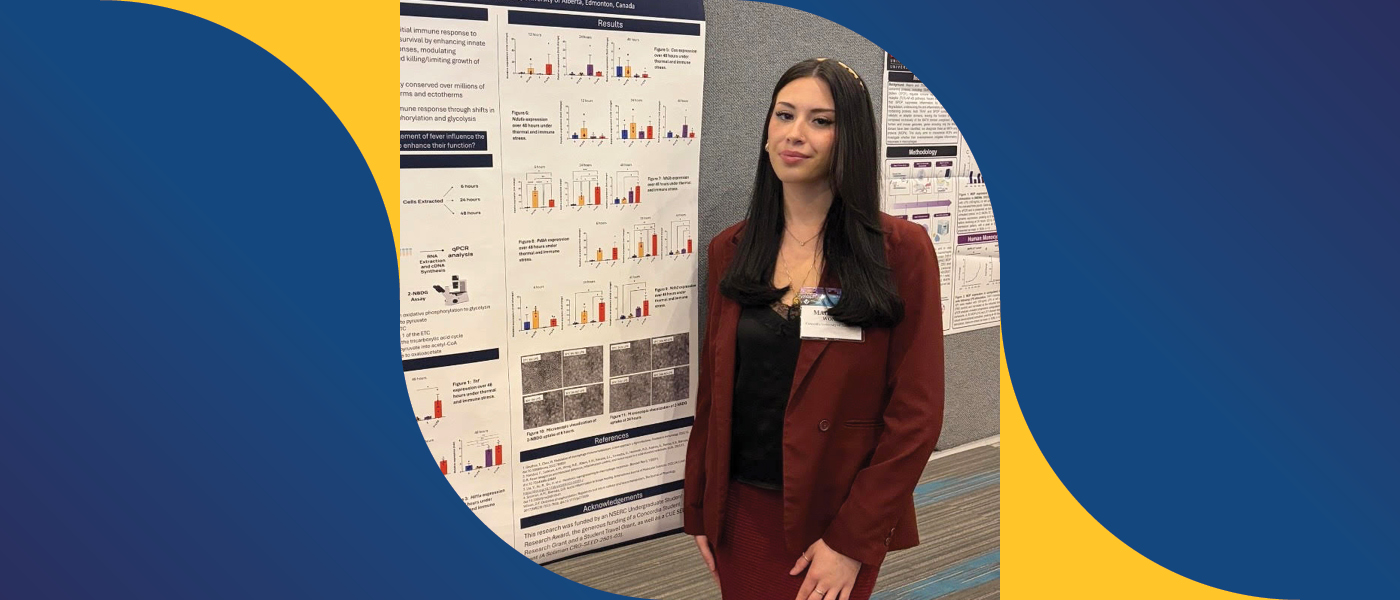
Student Research Spotlight: Madeline Wong
Redefining What It Means to Be an Undergrad Student
“You need dedication, you need to just show up everyday and keep doing what you’re doing. It takes continuity and things don’t always happen very quickly in research.”
For Madeline Wong, these aren’t just words, they’re a philosophy she has lived throughout her time as a Bachelor of Science, Biology student at Concordia University of Edmonton (CUE). From her very first year, Madeline arrived with a clear goal: to pursue medicine.
What she may not have anticipated was just how many doors would open along the way.
Her drive to seek out knowledge and hands-on experience has led her to multiple research assistant positions and her own independent research, an impressive accomplishment for any undergraduate student.
“I think that with Concordia (University of Edmonton) being such a small school, it creates an environment where your professors are a little bit more approachable and there’s more of a personal relationship between educators and students”.
A First Step Into Research
Madeline’s research journey began with an independent study course under Dr. Blessing Bassey Archibong.
What started as a classroom opportunity quickly evolved into something much bigger when she joined Dr. Bassey Archibong’s (Biological Sciences) research tracking specific biomarkers related to breast cancer and metastasis to the brain.
“I wrote a manuscript on the topic… I learned to do cell culture and aseptic technique … and the nuances of literature review and scientific communication of a complex topic.”
Exploring the Nervous System
Her next opportunity came when Dr. Matthew Churchward (Biological Sciences) brought her on as a research assistant to study FES (functional electrical stimulation) implantation devices for rehabilitation of patients with neurological conditions or CNS (central nervous system) injuries. The research focused on why these devices were failing inside the body, a phenomenon called glial scarring, and what role brain cells called astrocytes and microglia might play.
“… we were experimenting with the application of electrical stimulation on astrocytes and microglia… because of a phenomenon called glial scarring that was causing the devices to fail in the body. It was my job to investigate the cellular response to electrical stimulation through multiple different assay techniques”
Tackling Fever and the Immune System
Most recently, Madeline has shifted her focus to one of the body’s most fundamental, and still not fully understood, responses: fever.
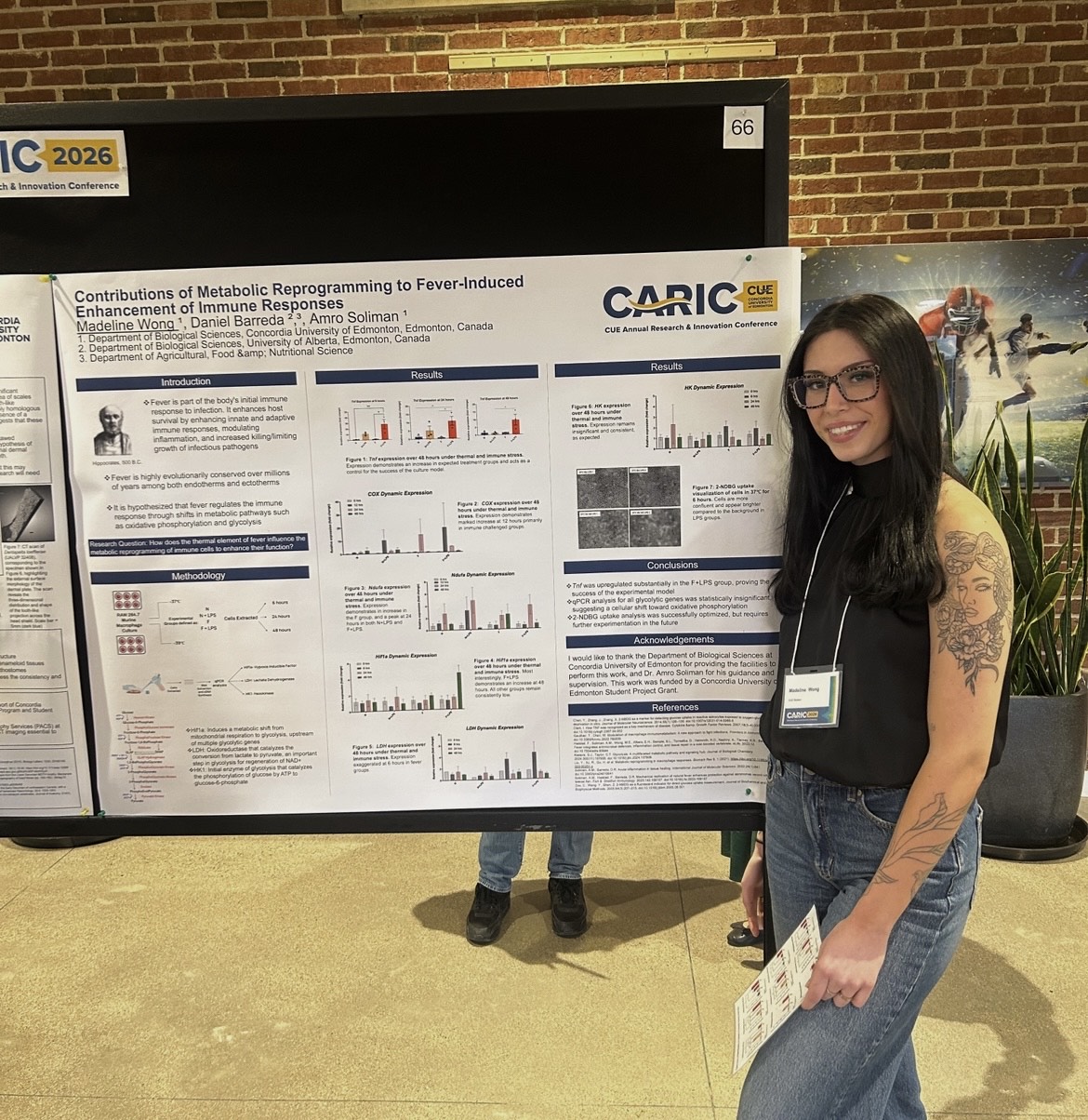
Approached to apply for an NSERC Undergraduate Student Research Award (USRA) under Dr. Soliman’s supervision, which she was awarded, Madeline is now working out of Dr. Daniel Barreda’s lab at the University of Alberta, investigating how fever temperatures affect metabolic pathways and gene expression in immune cells.
Together with Dr. Soliman, Madeline has had the opportunity to present their work at various research conferences across Canada such as the University of Alberta’s R.E. Peter Conference in Biological Sciences and The Canadian Society for Immunology’s 38th Annual Scientific Conference in Winnipeg, Manitoba, where she won third place in the Master’s Student Cohort for Best Poster Presentation.
“We don’t yet understand how fever modulates the immune response and augments it, but we hypothesize that it’s due to the metabolic shifts.
Building Community Beyond the Lab
Madeline’s ambitions don’t stop at the laboratory door. Inspired by the vibrant club cultures she saw at other universities and motivated by a desire to give back, she founded the CUE Pre-Health Society.
Open to any student with an interest in healthcare, regardless of their specific path, the society hosts talks from professionals across the health field, helping undergrads explore the many careers available to them after their undergrad degree.
It’s a natural extension of who Madeline is: someone who doesn’t just seize opportunities, but creates them for others too.
An Inspiration for What’s Possible
As Madeline prepares to complete her undergraduate degree, her story stands as a powerful reminder of what becomes possible when curiosity meets the right environment.
Through smaller class sizes, engaged faculty, and a culture of accessibility, CUE gave Madeline the foundation, and she built the rest herself.
“Dr. Blessing Bassey Archibong, Dr. Matthew Churchward, and Dr. Amro Soloman have been my main mentors and educators, and they’ve just been fantastic.”
For students considering their own path in health sciences, Madeline has a simple message: show up, stay curious, and don’t wait for opportunity to find you.
“You need dedication and just to continue every day doing what you’re doing.”.
———————————————————————————————————————
This profile is based on an interview conducted by Kira Sviderskaia, Research Assistant, Department of Medicine, Division of Infectious Diseases, University of Alberta, and Editor at Eureka! Undergraduate Science Journal.
Travel to The Canadian Society for Immunology’s 38th Annual Scientific Conference in Winnipeg, Manitoba was helped funded by the Concordia Student Travel Award.