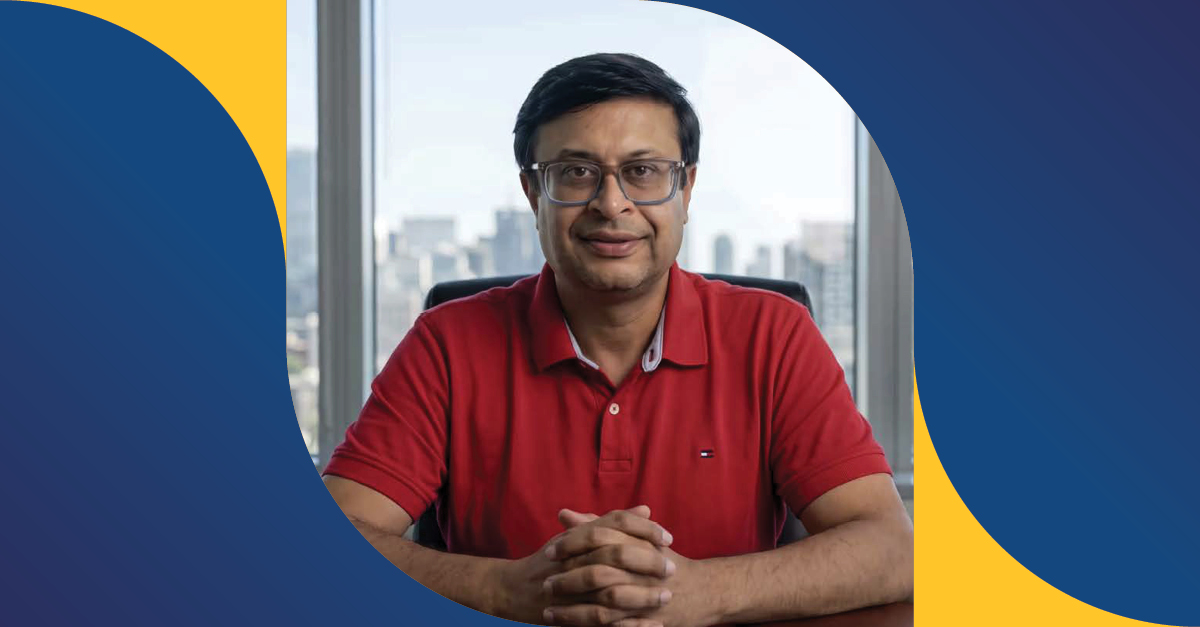
The Human in the Machine: Dr. Baidya Nath Saha on Building Better AI with Human Knowledge
An artificial intelligence system can analyze an image, identify a pattern, or generate an answer in seconds, but how would it know whether that answer is right?
For Dr. Baidya Nath Saha, a researcher in Concordia University of Edmonton’s (CUE) Faculty of Science, that question sits at the centre of his work. Through a $180,500 Natural Sciences and Engineering Research Council of Canada (NSERC) Discovery Grant awarded in 2020, Saha is exploring how human knowledge can be built into machine-learning algorithms to help them work more efficiently in real-world settings.
AI can process enormous amounts of information, but it still needs people to provide the knowledge, context, and judgment.
Why AI Still Needs People
Dr. Saha’s research looks at how expertise gained through research, experimentation, and professional experience can be incorporated into algorithms, reducing unnecessary processing and making better use of computing resources.
That knowledge comes from published studies, experiments, conversations with industry professionals, and interdisciplinary projects. Collaborating with doctors, physicists, and other subject-matter experts helps Dr. Saha and his team understand what an AI system needs to answer queries and what information it might be missing.
Dr. Saha describes this as keeping a “human in the loop.” An AI tool may produce several possible answers, but a person still needs to assess which result is correct. If the system misses something or reaches the wrong conclusion, human expertise helps identify the problem and guide improvements.

From Medical Images to Manufacturing
Dr. Saha has seen both the promise and the limits of machine learning over his career. In earlier research with a team at the University of Alberta, he helped develop automated methods for analysing MRI and CT scans to help radiologists assess whether a brain tumour was present and, if so, identify its type and stage.
Algorithms can spot patterns a person might overlook, but images do not always contain all the context a clinician needs. The goal is not to replace specialists; it is to help them work more efficiently in support of their professional judgment and experience.
Dr. Saha’s work also reaches into industrial applications. Through collaborations in Mexico, he has worked on manufacturing problems such as welding simulation. Simulating a welding sequence before carrying it out can help engineers identify an order that reduces heat-related deformation and material waste.
Commercial simulation tools can be expensive, putting them out of reach for some smaller businesses and research institutions. Dr. Saha is interested in developing open-source alternatives that make useful tools more accessible. For these systems to work, they must reflect real industrial processes, and engineers need the expertise to interpret their results.
Research That Integrates Students
Students are at the heart of research programs at CUE, by integrating projects, contributing to the advancement of the field, all while gaining research skills and competencies needed to succeed Dr. Saha examine where AI models make mistakes and how they can be improved. This gives students practical experience while developing the critical thinking needed to use the technology responsibly.
He brings the same principle into his classroom. Dr. Saha allows students to use AI tools for some assignments, but asks them to verify the answers, identify errors, and decide what should happen next. Rather than treating AI as a shortcut, students learn to question its output and understand its limitations.
What Comes Next for AI?
As his Discovery Grant approaches its conclusion, Dr. Saha is looking at how incorporating human knowledge could improve generative and agentic AI systems. These tools require substantial computing power, raising questions about energy use and environmental costs.
Dr. Saha wants to explore whether giving these systems more relevant knowledge can help them use fewer tokens (the units used to process and generate text) and reduce the computational resources required for some tasks. This next stage builds on the same central question: how can AI do more without losing the value of human expertise?
For Dr. Saha, progress in AI is not simply about making machines more capable, it’s about understanding where they are useful, recognizing where they fall short, and emphasizing human judgment in the process. As expectations for AI continue to grow, that partnership remains essential to making the technology work for the real world.
Acknowledgements
Dr. Saha’s research is supported by the Natural Sciences and Engineering Research Council of Canada (NSERC). Mitacs also supports student research internships connected to the broader research program.