
Dr. Jinny Menon, Faculty of Education, Receives a Social Sciences and Humanities Research Council (SSHRC) Insight Development Grant
Edmonton, AB – Concordia University of Edmonton (CUE) is excited to announce that Dr. Jinny Menon, Faculty of Education, has received an Insight Development Grant from the Social Sciences and Humanities Research Council of Canada (SSHRC) for work on artful and creative processes in the identity-making of youth of colour.
“My work is shaped by how peoples’ identities, cultures, and lived experiences inform their life, and the ways in which various systems (e.g., education, health care) can constrain or expand possibilities for belonging and care,” says Dr. Menon.
Using artful, relational, and heart-centred approaches, she works alongside children, families, and educators to bring forward stories that are often overlooked: stories of navigating identity and mental health, of resisting harmful narratives, and also, of joy, agency, and cultural strength.
Identity-Making Through Art
This project looks at a period of life that, for young people of colour, Dr. Menon says, remains understudied: the identity development of youth as they move from their late teens into early adulthood. During this time of life, racialized youth often must navigate discrimination, heightened visibility, and experiences that shape their racial identity in difficult ways, yet very little research has explored how they develop their sense of identity during this transition.
Dr. Menon, along with her research collaborators, Dr. Vera Caine (University of Victoria), Dr. Simmee Chung (Concordia University of Edmonton), Dr. Lynn Butler-Kisber (McGill University), Dr. Chloe Warren (University of New South Wales), and Dr. Dilma Mello (Federal University of Uberlândia), are exploring how artful and creative practices are being used across the social sciences, humanities, and professional disciplines to understand how youth of colour develop and express their identities.
An International, Youth-Centred Collaboration
“This [SSHRC] funding is crucial as it enables me to work with an interdisciplinary, international team of researchers, collaborating with colleagues in Canada, Australia, and Brazil,” says Dr. Menon. “It also allows us, as a team, to meaningfully include youth as active partners as we engage in this research.”
The project also provides two CUE undergraduate students with real world, immersive training in qualitative research, data analysis, and knowledge mobilization, along with experience in intercultural communication and engagement.
“Being at CUE, a smaller, more intimate university, has been instrumental in shaping my ongoing research practice,” said Dr. Menon. “The community atmosphere at CUE creates spaces for meaningful collaborations that perhaps, can be challenging to cultivate in larger, more siloed institutions.”
Acknowledgments
Dr. Jinny Menon acknowledges the generous support of the Social Sciences and Humanities Research Council of Canada (SSHRC), as well as her research partners and collaborators:
Dr. Vera Caine (University of Victoria), Dr. Simmee Chung (Concordia University of Edmonton), Dr. Lynn Butler-Kisber (McGill University), Dr. Dilma Mello (Federal University of Uberlândia), and Dr. Chloe Warren (University of New South Wales).
She also would like to thank:
Dr. Erika Goble, Director of CUE’s Office of Research and Innovation Services; Dr. Carla Craveiro Salvado, Associate Vice President, Research and Innovation and Dean, Graduate Studies; and Dr. Tim Cusack, Dean of Education, for their support and encouragement.
Dr. Jinny Menon remercie le Conseil de recherches en sciences humaines du Canada (CRSH) de son généreux soutien.
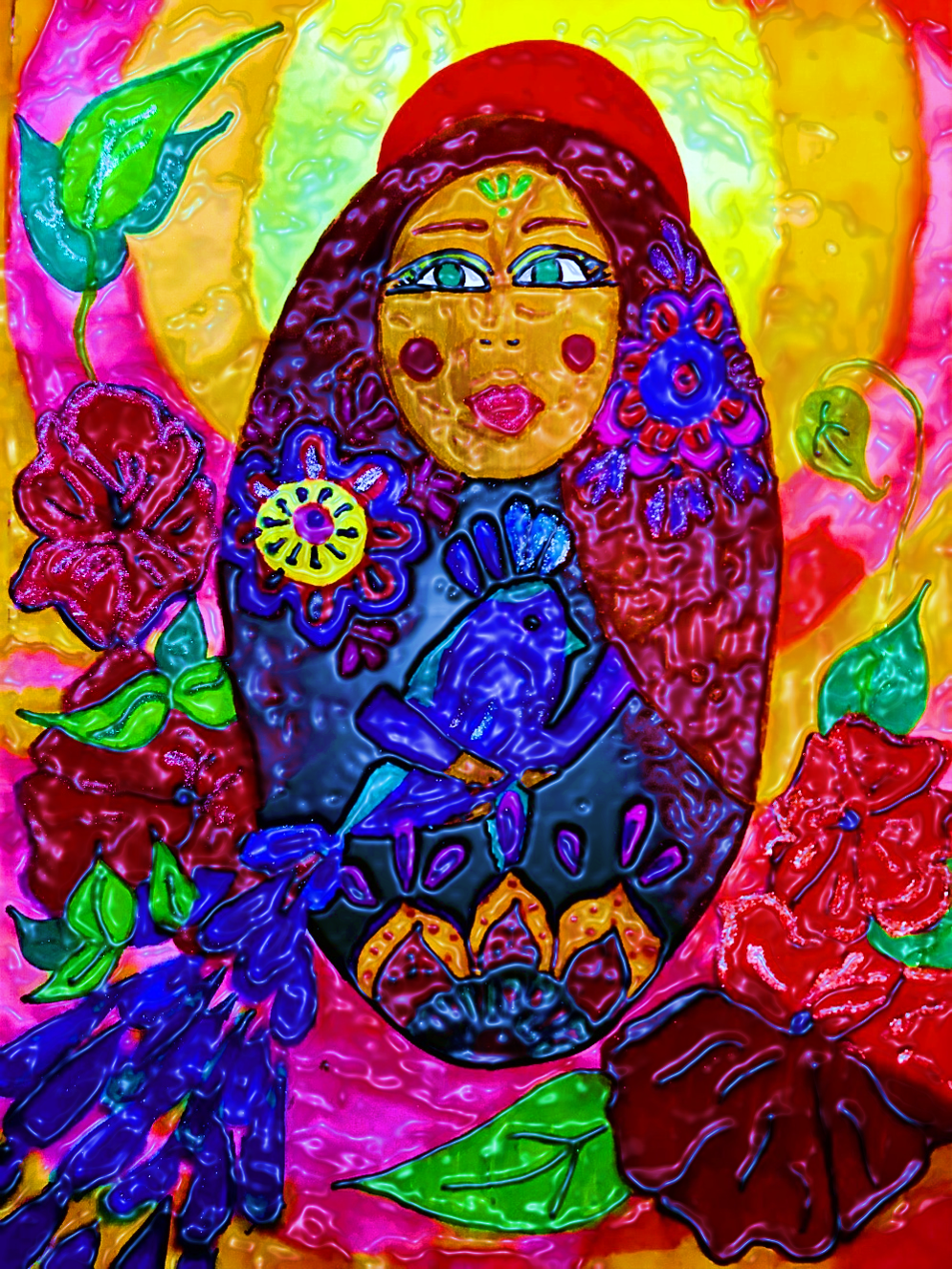
(water colour paints, varied inks, and mixed media)
This artwork grows out of my dissertation, An Artful Narrative Inquiry into the Curriculum-Making Experiences of South Asian Girls, Mothers, and Teachers in Canada, which explores the layered and rich storied experiences of South Asian girls, their mothers, and teachers, as they live, work, and learn within and spanning their unique worlds of home, school, family, culture, faith, and community. Using watercolour paints, varied inks, and mixed media, I sought to create visual compositions that capture the many hues of memory, identity, and belonging that imbued the diverse stories experienced by South Asian co-participants.