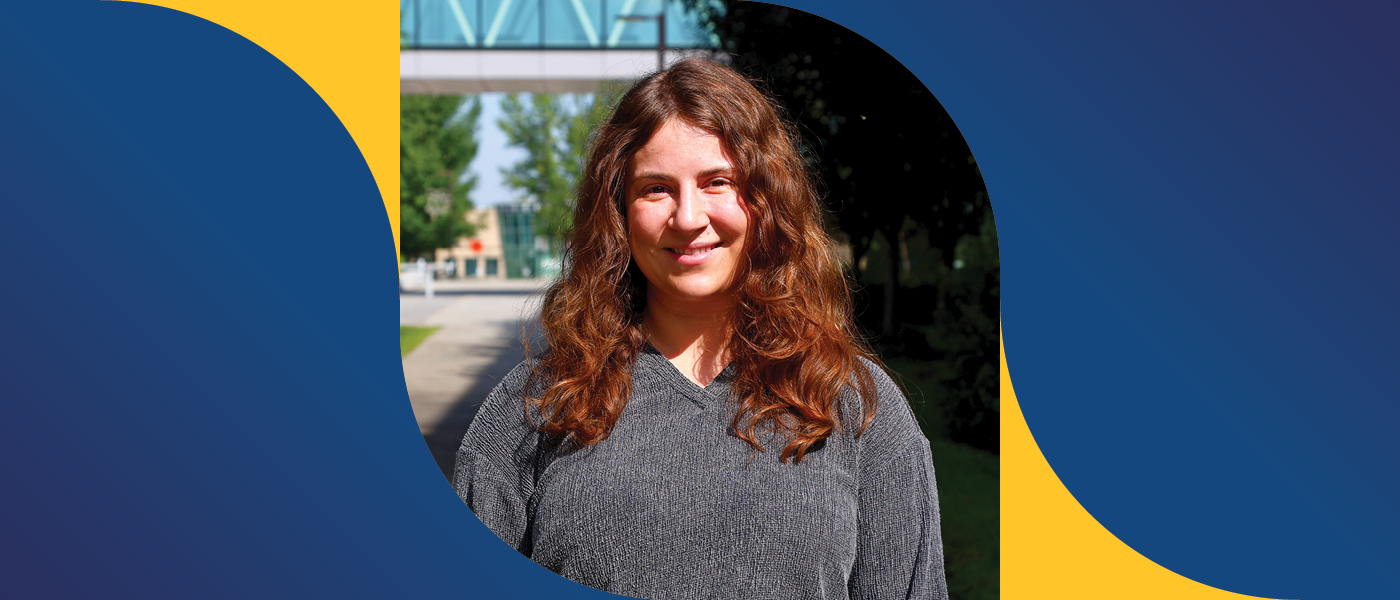
CUE’s Doctoral Student Rachel Mustaklem Receives a Prestigious SSHRC Canada Graduate Research Scholarship Award
Concordia University of Edmonton (CUE) is excited to share that Rachel Mustaklem, a Doctor of Clinical Psychology student, is the recipient of the Social Sciences and Humanities Research Council (SSHRC) Canada Graduate Research Scholarship – Doctoral program (CGR-D)! This award supports high-caliber doctoral students in the social sciences and humanities.
The award will support Rachel in her study of a very specific and often overlooked fast-growing field: therapists. Psychedelic-assisted psychotherapy (PAP) pairs substances like psilocybin, ketamine, or MDMA with talk therapy to treat conditions like treatment-resistant depression.
Rachel’s work looks past the medicine and focuses on the person guiding the room. “Their values… likely affect how therapists relate to patients , and make decisions during therapy,” she explains, and in PAP, where patients can be unusually vulnerable and open to deeply personal or even spiritual experiences, that influence carries real consequences shaping how safe and effective the experience feels.
A Seed Planted in High School
Rachel’s interest traces back to a high school conversation about the Mazatec use of psilocybin mushrooms in healing ceremonies.
That discovery led Rachel to understand how altered states of consciousness could be applied to healing.
The early curiosity never let go, carrying her all the way to CUE’s PsyD program, where she can now explore it further.
Tackling a Path Unchartered by Others
While most PAP research focuses on how well the treatment works, Rachel is asking a different question: how therapists actually practice it. Right now, while the medical and structural sides of PAP are standardized, the talk-therapy portion is not, and currently very little is documented about how therapists are trained or what they bring into session.
“While there have been many different proposed standards of practice for the talk portion of PAP, none of these have reached consensus,” she says. “We need to understand how PAP therapists actually practice PAP because it’s such a new practice. .”
Understanding it is critical “so that we can make PAP safer, ethical, and as effective as possible.”
A Milestone Years in the Making
For Rachel, the SSHRC CGS-D award is the realization of a goal she’s held since her second year of undergrad, when she first set her sights on a doctoral program like CUE’s PsyD.
She cried tears of joy when she found out she was awarded a SSHRC CGS-D, a recognition of her work and the growing legitimacy of PAP research as a whole.
“I am just excited that a PAP project got funding,” she says, pointing to rising public interest and government investment in the field as it becomes more established.
Throughout it all, she credits her partner and daughters for their steady support in helping her get here.
Small School, Wide-Open Doors
Rachel credits CUE’s size for research opportunities she says she wouldn’t have found at a larger university, where labs tend to stay siloed. At CUE, she’s collaborated across academic disciplines, with researchers like Dr. Alexander Taikh, on a psycholinguistics project – which is entirely outside her own field – which has resulted in a manuscript now under review. It’s exactly the kind of cross-field collaboration she says happens naturally at CUE.
Her supervisor, Dr. Thea Comeau, is Rachel’s role model and biggest support, someone who helped her sharpen an ambitious, wide-ranging vision, bridging two distinct bodies of literature, into a focused project ready to compete for national funding, all while keeping true to what drew Rachel to the work in the first place.
As PAP moves from the margins into mainstream mental health care, Rachel’s research points toward a future where the people delivering this treatment are held to the same rigor as the treatment itself.
Acknowledgments
CUE and Rachel Mustaklem gratefully acknowledge the Social Sciences and Humanities Research Council (SSHRC) for Rachel’s SSHRC Canada Graduate Research Scholarship – Doctoral program (CGR-D).
CUE et Rachel Mustaklem remercient le Conseil de recherches en sciences humaines (CRSH) pour la bourse d’études supérieures du Canada au niveau doctoral (BESC D) accordée à Rachel.